
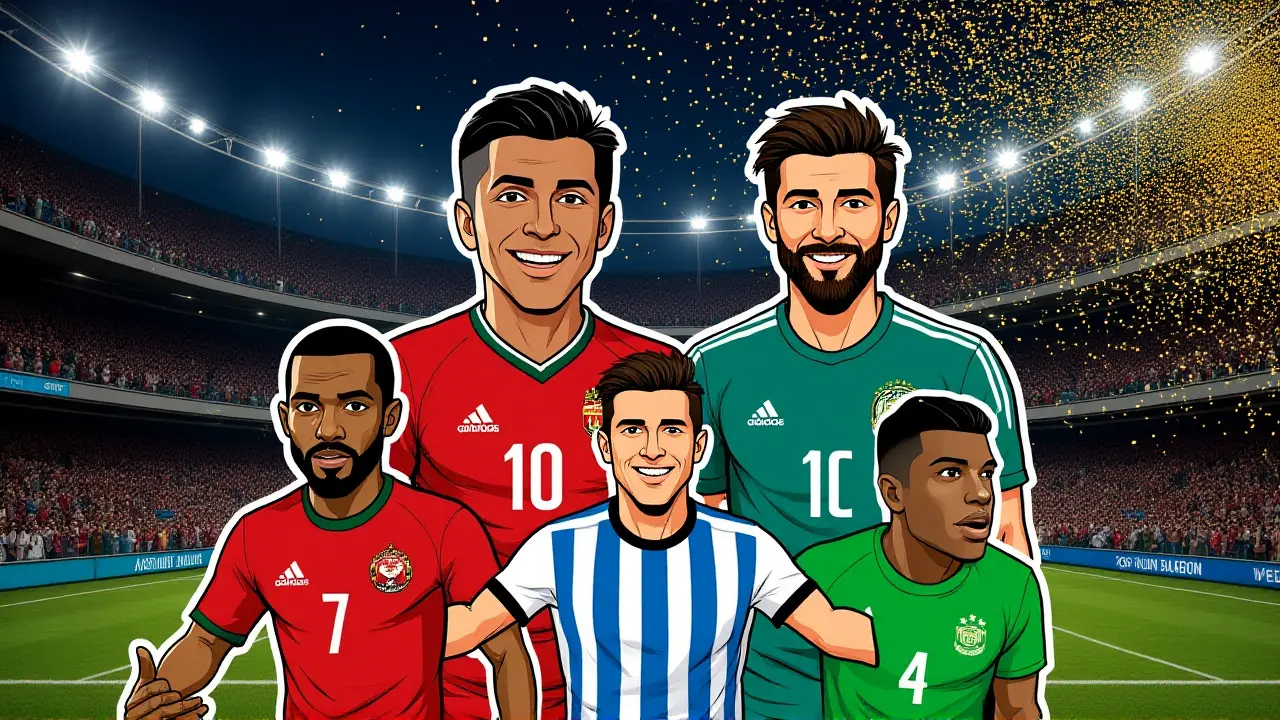
The wait is finally over. The 2026 FIFA World Cup North America has officially entered its most brutal phase: the Round of 32. Starting Sunday, June 28, and running through Friday, July 3, sixteen single-elimination matches will determine which teams survive to chase glory and which go home empty-handed. It’s not just a tournament anymore; it’s a gauntlet.
Here’s the thing about this expanded format—there are no second chances. With 12 groups in the preliminary stage, the path to the knockout rounds was wider, but now the field narrows sharply. The top two from each group plus the eight best third-placed teams have punched their tickets. Now, they face off across venues in the United States, Mexico, and Canada. If you’re planning your viewing party or booking flights, you need the details right.
How the Knockout Bracket Works
Unlike previous tournaments with 16 teams entering the knockouts, this year features 32. That means more games, more drama, and a complex seeding system designed to reward group performance. FIFA has structured the bracket so that group winners generally face runners-up or strong third-placed teams, while weaker runners-up clash with each other.
The logic is straightforward but unforgiving. Match numbers 73 through 88 dictate the pairings. For instance, the winner of Group A plays a third-place team from specific pools, while the runner-up of Group A faces the runner-up of Group B. This ensures that dominant group winners aren’t immediately paired against other dominant winners, preserving competitive balance for as long as possible. But let’s be clear: in a penalty shootout, past performance doesn’t matter much.
Opening Day: Canada Starts the Run
The curtain rises on Sunday, June 28, with a high-stakes clash between South Africa and Canada. This isn’t just any opener; it’s a statement game. Canada, finishing second in Group B, hosts South Africa, who secured second place in Group A. The match takes place at SoFi Stadium in Inglewood, California—a venue known for its electric atmosphere.
Reports indicate Canada edged out South Africa 1-0 in this fixture. That single goal could define their entire campaign. Playing at home soil (or close enough to feel like it) gives Canadian fans a massive boost. The local kickoff was set for noon Pacific time, catching early risers across North America. It sets the tone: tight defenses, tactical caution, and one moment of brilliance deciding everything.
Monday’s Heavy Hitters: Brazil, Germany, and the Netherlands
Monday, June 29, brings three marquee matchups that promise fireworks. First up is Brazil vs Japan. Brazil, topping Group C, faces Japan, who finished second in Group F. The game lands at NRG Stadium in Houston, Texas. Expect speed, skill, and intense physicality. Brazil’s attack versus Japan’s disciplined counter-pressing is a classic stylistic clash.
Later that day, Germany meets Paraguay near Boston. Germany, winning Group E, takes on Paraguay, who qualified as a third-place team. The venue is Gillette Stadium in Foxborough, Massachusetts. This is a test of German efficiency against Paraguayan grit. Then, the Netherlands face Morocco. The Dutch topped Group F, while Morocco came second in Group C. Their meeting at Estadio BBVA in Monterrey, Mexico, is arguably the toughest tie of the day. Two African-North African powerhouses colliding? Count on chaos.
Tuesday’s Showdowns: France, Mexico, and Ivory Coast
Tuesday, June 30, heats up with Ivory Coast vs Norway in Arlington, Texas. Both teams finished second in their respective groups (E and I), making this a pure battle of survival. No favorites here. Just two sides desperate to advance.
The real eye-catcher, however, is France vs Sweden. France won Group I, while Sweden scraped in as the third-best third-place team from Group F. They meet at MetLife Stadium in East Rutherford, New Jersey. French flair against Scandinavian structure. It’s a mismatch on paper, but knockout football loves an underdog story.
Meanwhile, in Mexico City, host nation Mexico faces Ecuador. Mexico topped Group A, and Ecuador earned their spot as a third-placed qualifier. The atmosphere at Estadio Azteca will be deafening. Losing at home would be catastrophic for Mexican football; advancing feels mandatory.
Wednesday’s Global Clash: England, USA, and Belgium
Wednesday, July 1, shifts focus to transatlantic giants. England faces the Democratic Republic of Congo in Atlanta. England dominated Group L, while DR Congo impressed enough to finish third in Group K. This is England’s first real test of depth and composure away from European crowds.
In the San Francisco Bay Area, the United States hosts Bosnia and Herzegovina. The US won Group D, securing home advantage in Santa Clara. Bosnia, qualifying via third place, brings European experience. American fans will hope for another historic run, building on recent successes.
Rounding out the day, Belgium plays Senegal in Seattle. Belgium’s golden generation faces Senegal’s youthful energy. At Lumen Field (referred to as Seattle Stadium in some broadcasts), the noise level will be incredible. Belgium needs to prove they’re still contenders; Senegal just needs to believe.
Thursday and Friday: Portugal, Spain, Argentina, and More
Thursday, July 2, starts in Toronto with Portugal vs Croatia. Two European heavyweights collide. Portugal’s individual brilliance against Croatia’s tactical unity. Then, Spain faces Austria in Los Angeles. Spain’s possession game meets Austrian aggression. Finally, Switzerland plays Algeria in Vancouver. Switzerland won Group B; Algeria qualified third. A tough, physical affair expected.
The final day, Friday, July 3, wraps up the round. Argentina faces Cape Verde in Miami. Lionel Messi’s last dance? Or a new era begins? Colombia plays Ghana in Kansas City. Speed vs Power. And Australia meets Egypt in Dallas. An Asian-African showdown that promises passion and unpredictability.
Why This Matters Beyond the Scores
This expanded format changes everything. More teams mean more nations get to play on the biggest stage. Economies in smaller footballing nations benefit from increased visibility and revenue. For fans, it’s six days of non-stop action instead of four. But it also dilutes the prestige slightly. Is winning the Round of 32 as impressive when half the world is playing? Maybe. But the emotion remains raw.
Broadcasters like FOX Sports, ESPN, and Al Jazeera are covering every angle. Ticket prices soared, but secondary markets offer options. Whether you’re watching in a bar in Lagos, a living room in London, or a stadium in São Paulo, the connection is universal. Football unites us, even when it breaks our hearts.
Frequently Asked Questions
When does the Round of 32 start and end?
The Round of 32 begins on Sunday, June 28, 2026, and concludes on Friday, July 3, 2026. All 16 matches are played within this six-day window, with winners advancing immediately to the Round of 16.
Which teams play in the opening match?
The tournament opens with South Africa vs Canada at SoFi Stadium in California. Canada advanced as the runner-up of Group B, while South Africa finished second in Group A. Reports suggest Canada won 1-0.
Where can I watch the matches live?
In the US, FOX and FS1 hold broadcasting rights. Internationally, networks like Sky Sports, Al Jazeera, and ESPN provide coverage. Streaming services often mirror these channels. Check local listings for exact times in your time zone.
How are the matchups determined?
FIFA uses a fixed bracket based on group positions. Group winners typically face runners-up or strong third-placed teams. Specific pairings are pre-determined by match numbers (73-88) linked to group letters (A-L).
What happens if a match ends in a draw?
Knockout matches cannot end in a draw. If scores are tied after 90 minutes, there is 30 minutes of extra time. If still tied, the winner is decided by a penalty shootout.
 Sports